

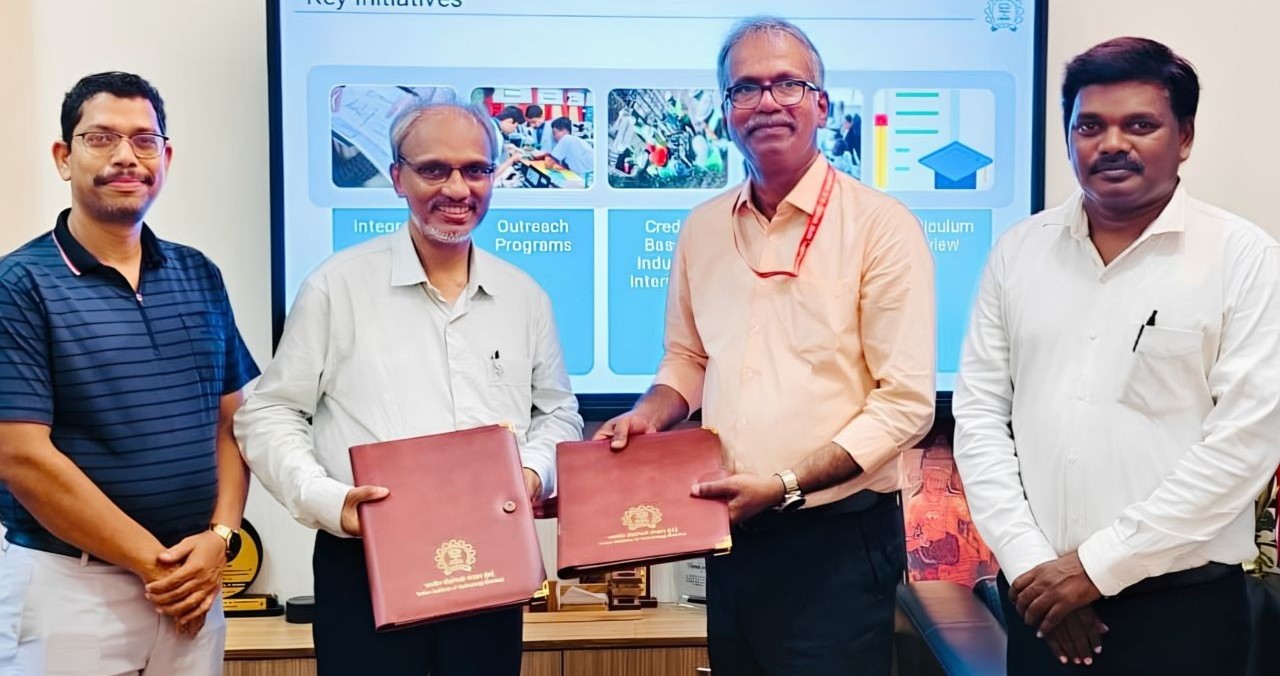
A tripartite agreement signed at IIT Bombay brings DGMA, IIT Bombay and IIFCL Projects together to support appraisal, monitoring and compliance for brownfield shipyard modernisation under India’s Shipbuilding Development Scheme.
Make us preferred source on Google
Key Takeaways
- A Tripartite Project Agreement was signed on 17 September 2026 at IIT Bombay between the Directorate General of Maritime Administration (DGMA), IIT Bombay and IIFCL Projects Ltd.
- The agreement establishes a Project Management Unit (PMU) for the Brownfield Capacity Expansion component of the Shipbuilding Development Scheme (SbDS).
- The PMU is intended to support project appraisal, monitoring, compliance management and implementation.
- The Government’s SbDS has a ₹19,989 crore outlay and aims to expand India’s annual shipbuilding capacity to 4.5 million Gross Tonnage (GT). (Press Information Bureau)
- Existing shipyards can receive capital assistance for brownfield expansion and upgrading critical infrastructure, with the official scheme framework providing for assistance of up to 25% for eligible brownfield projects. (Ministry of Shipping)
Also Read: Vadhavan Port Tender Advances as NAPM Demands Project Halt and Independent Impact Assessment
Mumbai, Maharashtra, India, September 23, 2026 (Maritime News): India’s effort to expand domestic shipbuilding capacity has moved into another implementation phase with the signing of a tripartite agreement involving the Directorate General of Maritime Administration, IIT Bombay and IIFCL Projects Ltd.
According to the Directorate General of Shipping’s September 17 announcement, the agreement was signed at IIT Bombay and creates a dedicated Project Management Unit to support projects under the Brownfield Capacity Expansion component of SbDS.
The PMU is expected to work across four areas: appraisal, monitoring, compliance management and implementation of shipyard-modernisation projects.
The arrangement brings together maritime administration, an academic and technical institution, and an infrastructure-advisory organisation.
What Is Brownfield Capacity Expansion?
Brownfield expansion refers to expanding the capacity of an existing shipyard, rather than establishing an entirely new shipyard.
The Ministry of Ports, Shipping and Waterways’ guidelines define Brownfield Capacity Expansion as a capacity-expansion project undertaken by shipyards to augment their shipbuilding and ship-repair facilities. The guidelines provide for Government capital assistance towards eligible items under the scheme. (Ministry of Shipping)
The official framework also states that the SbDS and its guidelines apply to applications approved from 24 September 2025 through 31 March 2036. (Ministry of Shipping)
The Government’s broader shipbuilding package has positioned brownfield expansion alongside greenfield shipbuilding clusters, shipbuilding risk coverage and capability-development initiatives.
The SbDS itself carries an outlay of ₹19,989 crore, including ₹9,930 crore for greenfield clusters, ₹8,261 crore for brownfield capacity expansion, ₹1,443 crore for shipbuilding risk coverage and ₹305 crore for capability-development initiatives. (Press Information Bureau)
Why a Project Management Unit Matters
The announcement is significant because the challenge in shipbuilding is not limited to approving financial assistance.
A shipyard-modernisation project has to move through multiple stages:
Project proposal → appraisal → approval → financial assistance → procurement/construction → compliance → monitoring → capacity creation → ship production/repair.
A PMU can provide an institutional mechanism to track these stages.
The precise responsibilities and authority of the newly established PMU, however, should be assessed against the Tripartite Project Agreement and its operating framework. The public announcement establishes its broad functions but does not, by itself, provide detailed project-level targets, timelines or individual shipyard allocations.
That distinction matters when measuring implementation.
India Is Building Both Greenfield and Brownfield Capacity
The PMU comes against a broader expansion of India’s shipbuilding ecosystem.
In July 2026, the Ministry announced in-principle approval under SbDS for a Greenfield Shipbuilding Cluster at Porbandar, Gujarat, and a ₹1,570-crore ship-repair facility at Vadinar, jointly developed by Cochin Shipyard Ltd and Deendayal Port Authority. The Vadinar project was approved for 25% financial assistance on eligible capital infrastructure. (Press Information Bureau)
The Government’s stated objective is to develop India into a stronger global shipbuilding and ship-repair hub.
A Rajya Sabha reply in August 2026 stated that proposals for greenfield clusters in Andhra Pradesh, Gujarat and Tamil Nadu, along with three brownfield capacity-expansion projects, had received in-principle approval after appraisal by the National Shipbuilding Mission (NSbM). (Press Information Bureau)
Also Read: : Before India Maps “Vacant” Port Land, Who Will Map the People, Rights and Nature on It?
From Shipyard to the Wider Maritime Economy
Shipbuilding policy does not end at the shipyard gate.
A new or modernised shipyard creates demand across a much wider industrial and maritime chain.
| Stakeholder | Possible connection to shipbuilding expansion |
|---|---|
| Shipyards | Higher production and repair capacity |
| Shipyard workers | Construction, fabrication and repair employment |
| Engineers and naval architects | Design, technical and project-management demand |
| Steel and equipment manufacturers | Increased demand for maritime components |
| MSME suppliers | Ancillary manufacturing and services |
| Logistics operators | Movement of steel, machinery and project cargo |
| Ports and terminals | Handling of shipbuilding-related cargo and equipment |
| Freight forwarders | Project-cargo and industrial logistics coordination |
| Customs Brokers | Import clearance for eligible machinery, equipment and components |
| Shipping lines | Transport of imported and exported industrial cargo |
| Shipowners | Potential increase in domestic vessel construction and repair options |
| Seafarers | Potential employment demand as vessel construction and fleet activity expand |
The official SbDS framework itself describes the broader objective as capacity and ecosystem development, while the Government has linked the programme to increasing domestic shipbuilding capacity and associated skills. (shipbuilding.dgshipping.gov.in)
The Seafarer Link Begins With the Ship
There is also a human connection between shipbuilding policy and seafarer employment.
The chain is:
Trade → Cargo → Ships → Shipbuilding → Fleet capacity → Voyages → Manning → Seafarer employment
A shipbuilding programme therefore has implications beyond industrial production. If additional vessels are ultimately built and operated, the maritime employment chain can extend to officers, ratings, engineers and other maritime professionals.
But this should be measured rather than assumed.
The creation of shipyard capacity does not automatically establish a corresponding number of seafarer jobs. The eventual employment effect depends on vessels constructed, ownership and operation, fleet deployment, vessel types, repair activity and other factors.
Also Read: India–MERCOSUR Trade Talks Open as South American Cargo Opportunity Expands
The Financing and Policy Architecture Is Expanding
SbDS forms part of a wider Government package announced in September 2025.
The package includes:
- ₹24,736 crore Shipbuilding Financial Assistance Scheme (SBFAS);
- ₹25,000 crore Maritime Development Fund;
- ₹19,989 crore SbDS; and
- associated legal, policy and process reforms. (Press Information Bureau)
The Maritime Development Fund includes a ₹20,000 crore Maritime Investment Fund and a ₹5,000 crore Interest Incentivization Fund, according to the Government. (Press Information Bureau)
This means the September 17 agreement should be viewed as one part of a much larger attempt to create an integrated shipbuilding ecosystem rather than as an isolated administrative agreement.
Who Is Responsible for Delivery?
The implementation structure now involves several institutional layers.
Government / Ministry: policy, funding framework and programme direction.
National Shipbuilding Mission: the Government has identified NSbM as the nodal inter-ministerial body overseeing shipbuilding schemes including SBFAS and SbDS. (Press Information Bureau)
Maritime Administration: technical and regulatory functions associated with the scheme.
IIT Bombay: technical and academic expertise under the new collaboration.
IIFCL Projects Ltd: project-appraisal and infrastructure-advisory capabilities. IIFCL Projects Ltd describes itself as a wholly owned subsidiary of IIFCL, a Government of India enterprise, with services including project appraisal and infrastructure consultancy. (IIFCL Projects)
Shipyards: execution of approved brownfield expansion projects and achievement of the intended capacity outcomes.
The critical implementation question will therefore be measurable:
What was approved, what was funded, what was constructed, what capacity was actually added, and when did that capacity become operational?
Also Read: Hormuz Crisis Reshapes Gulf Shipping: What It Means for Indian Trade, Freight and Seafarers
A Capacity Target Needs a Capacity Audit
The Government has set a national objective of increasing annual shipbuilding capacity to 4.5 million GT under SbDS. (Press Information Bureau)
That creates a straightforward accountability framework.
Future monitoring can examine:
- Number of brownfield projects approved.
- Project value approved.
- Government capital assistance sanctioned.
- Funds actually released.
- Physical infrastructure completed.
- Additional dry-dock, fabrication, lifting or automation capacity created.
- Increase in installed shipbuilding capacity.
- Actual vessel production.
- Ship-repair capacity created.
- Direct and indirect employment generated.
- MSMEs integrated into the supply chain.
- Training and skilled-worker outcomes.
- Actual utilisation of newly created capacity.
The Ministry’s 2026-27 output framework already identifies increased installed shipbuilding capacity as an outcome indicator for SbDS. (Ministry of Shipping)
That provides a basis for moving beyond announcements and measuring physical results.
What It Means for India’s Maritime Industry
The significance of the September 17 agreement is therefore less about the signing ceremony itself and more about the implementation system being put around India’s shipyard-modernisation programme.
If the PMU performs its stated functions effectively, it can provide a structured mechanism for following projects from appraisal through compliance and implementation.
The next evidence will come from the projects themselves: construction, modernisation, capacity addition, production, repair activity, employment and utilisation.
MaritimeNews Insight
India’s shipbuilding strategy is moving from policy announcement towards project implementation. The new PMU adds another layer to that architecture.
The important measure over the coming years will be whether financial assistance and institutional support translate into functioning shipyard infrastructure and measurable additional capacity.
For the wider maritime economy, the test ultimately extends beyond the shipyard: whether Indian steel, equipment manufacturers, MSMEs, logistics providers, ports, shipowners, workers and seafarers participate in the value created by expanded domestic shipbuilding.
What to Watch
- Publication of the detailed PMU operating framework.
- Identification of brownfield projects covered by the arrangement.
- Project-wise investment and Government assistance.
- Modernisation milestones and completion dates.
- Actual capacity added against approved capacity.
- Vessel construction and repair output.
- Employment and skill-development outcomes.
- Participation of Indian MSMEs and ancillary manufacturers.
- Future vessel orders generated for Indian shipyards.
- Evidence of the scheme’s contribution to India’s 2030 and 2047 maritime objectives.
Frequently Asked Questions (FAQs)
What is the Shipbuilding Development Scheme?
SbDS is a Government of India programme designed to expand India’s shipbuilding capacity and develop the wider shipbuilding ecosystem. Its approved outlay is ₹19,989 crore. (Press Information Bureau)
What is brownfield capacity expansion?
It refers to expansion of existing shipyards to augment shipbuilding and ship-repair facilities. (Ministry of Shipping)
What is the new Project Management Unit?
The September 17 agreement establishes a dedicated PMU to support appraisal, monitoring, compliance management and implementation of brownfield shipyard-modernisation projects, according to the DGMA/DGS announcement supplied for this report.
Who signed the agreement?
The agreement was between the Directorate General of Maritime Administration, IIT Bombay and IIFCL Projects Ltd.
What is the target for India’s shipbuilding capacity?
The Government has set a target of 4.5 million GT of annual shipbuilding capacity under SbDS. (Press Information Bureau)
Does shipyard expansion automatically create seafarer jobs?
Not automatically. Additional seafarer employment depends on the number and type of vessels ultimately built and operated, fleet deployment, repair activity and associated maritime operations.
Also Read: Development of Non-Major Ports in India through Convergence
The September 17 agreement at IIT Bombay adds a project-management mechanism to India’s broader shipbuilding-capacity programme.
With SbDS combining greenfield clusters, brownfield expansion, risk coverage and capability development, the implementation challenge now shifts toward project execution and measurable outcomes.
For MaritimeNews, the eventual benchmark is clear: not simply how many agreements are signed, but how much shipbuilding capacity is actually created, how many vessels are built or repaired, how many industrial and maritime workers participate, and how much of the resulting maritime value remains within India’s wider ecosystem.
Sources
- Ministry of Ports Shipping and Waterways — SbDS Brownfield Capacity Expansion Guidelines
- Ministry of Ports Shipping and Waterways — Shipping Guidelines
- PIB — Government Shipbuilding Development Scheme and maritime financing package
- PIB — Shipbuilding promotion and maritime financing
- PIB — Porbandar Greenfield Cluster and Vadinar Ship Repair Facility
- IIFCL Projects Limited
- IIFCL Projects Limited — Projects
- Directorate General of Shipping, India — 17 September 2026 LinkedIn announcement on the Tripartite Project Agreement (source supplied for this report).
Make us preferred source on Google
Reporting by MaritimeNews Bureaus, Writing by Harpal S Naol; Editing by Jaspal Singh Naol.