

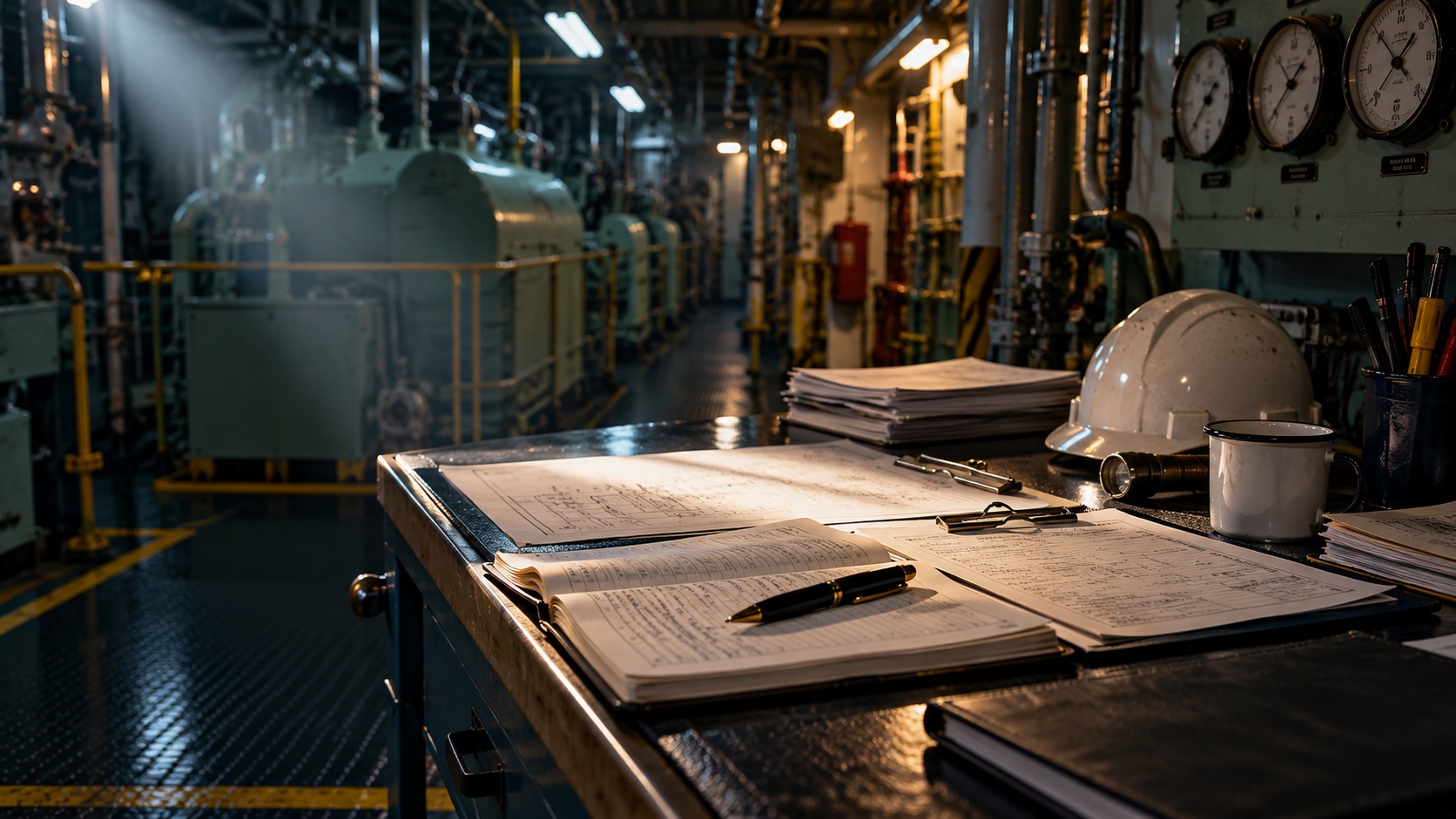
How One Reporting Marine Engineer’s Documents Raise Questions About Maintenance Culture, Crew Welfare and Safety at Sea
Publication Status: Serialized Dossier | First Published: 30 August 2026
Make us preferred source on Google
Editorial Mission
The maritime industry is sustained by professional competence, disciplined operations and continuous learning. Every day, merchant vessels move the energy, food, raw materials and manufactured goods upon which global trade depends. Behind each safe voyage are marine engineers, masters, deck officers, ratings, shore-based managers, superintendents, surveyors, regulators and many other professionals whose work is often most visible only when something goes wrong.
Maritime safety is not created by certificates and inspections alone. It is also produced through thousands of routine decisions: whether defects are reported accurately; whether planned maintenance is completed to the required standard; whether temporary repairs are controlled; whether critical spares are available; whether risk assessments reflect actual conditions; whether crew members can raise concerns without fear; and whether shore management converts reports into timely, verified action.
These processes form part of a vessel’s broader safety-management and maintenance culture. An effective system is visible not only in records, but in the identification, assessment, escalation, rectification and close-out of defects and near misses. It also depends on competent staffing, adequate rest, suitable living conditions, clear communication and organizational willingness to learn from weak signals before they become casualties.
It is in this professional and public-interest context that Maritime News Dossiers has been established.
Unlike a conventional news report, a Maritime News Dossier is a structured, evidence-led editorial publication. It examines documents, images, technical observations and responses over a defined sequence of articles. Its purpose is to test what can responsibly be learned from a documented operational experience, while clearly distinguishing verified information, source material, personal account and editorial analysis.
The Dossier does not determine civil or criminal liability, declare a vessel seaworthy or unseaworthy, issue deficiencies, or replace any statutory investigation, class survey, port State control inspection, flag-state process or judicial proceeding. Where the publication uses the term “investigation,” it refers to an editorial examination of supplied material. Final determinations remain the responsibility of the competent authorities and tribunals empowered to make them.
About Dossier 001
The Cost of Silence is the inaugural publication in the Maritime News Dossier series.
The Dossier examines documentary material, photographs and written observations supplied by a reporting marine engineer who states that he served onboard MT Chapel (IMO 9254070) during 2025. Following completion of his contract, he approached Maritime News and provided internal correspondence, images and a detailed account of his operational experience.
The material reviewed by the editorial team raises questions relevant to several interconnected areas of shipboard and shore-based management:
- Maintenance culture and planned maintenance
- Machinery condition, criticality and reliability
- Defect reporting, escalation and close-out
- Crew welfare, habitability and safe performance
- Environmental protection practices
- Safety-management effectiveness
- Shore-vessel communication and governance
- Organizational learning and prevention
The existence of a document, photograph or reported observation is not treated as automatic proof of cause, duration, responsibility, regulatory breach or operational consequence. Each item must be considered according to its provenance, date, completeness, technical context and available corroboration.
Although the series begins with one vessel and one professional account, its editorial purpose is broader. It asks whether the documented material can illuminate recurring industry questions about how concerns are identified, communicated, prioritized and resolved—and what may be lost when weak signals remain isolated within individual files or experiences.
Why This Dossier Matters
Shipping has often improved through the formal investigation of serious events. Collisions have strengthened bridge resource management and navigational practice. Groundings have influenced passage planning and situational awareness. Engine-room casualties have exposed weaknesses in maintenance, redundancy and emergency response. Pollution incidents have driven changes in equipment, procedures, recordkeeping and enforcement.
Formal casualty investigations are essential, but they usually begin after harm, loss or a reportable event. Many technically significant conditions do not reach that threshold. A machinery defect may be temporarily managed without immediate failure. A maintenance backlog may persist without detention. A welfare concern may affect morale and concentration without producing a recordable injury. A communication failure may remain buried in correspondence until the individuals involved leave the vessel or company.
In reliability engineering and safety management, these conditions may be understood as weak signals: information that does not prove an imminent casualty but may indicate degradation in equipment, controls, supervision, resources or organizational response. Professional learning depends on examining such signals carefully—without exaggerating them and without dismissing them merely because no accident followed.
This Dossier therefore asks a preventive question:
Can the maritime industry learn from documented operational experiences before they become accident investigations?
That question does not assume that every concern is correct, every defect is critical, or every disagreement reveals systemic failure. It requires disciplined examination of evidence, technical significance, available safeguards, reporting pathways and the responses of those responsible for managing risk.
The Cost of Silence is built around that discipline.
The Central Question
Every Maritime News Dossier is organized around one defining question. For Dossier 001, that question is:
How does a professional marine engineer reach the point where he believes that preserving documents and approaching the media is necessary to help prevent other seafarers from encountering similar conditions?
The series will examine both parts of that question: the operational concerns described by the reporting marine engineer, and the channels through which those concerns were reportedly raised, escalated, answered or left unresolved. It will not presume that external publication was the only available or appropriate route. Nor will it treat the reporting engineer’s belief as an established finding. The purpose is to understand how that belief developed and what the record may reveal about reporting culture and organizational response.
The answer, to the extent the available evidence supports one, is developed across the interconnected Parts that follow.
Scope of the Investigation
This Dossier examines one reporting marine engineer’s documented experience during a defined period of service onboard MT Chapel. The editorial review focuses on:
- Professional observations reportedly made during service
- Internal reporting and escalation of operational concerns
- Documentary material reviewed by Maritime News
- Photographic material supplied by the reporting marine engineer
- The engineering function and criticality of relevant machinery or systems
- Maintenance planning, defect management and corrective-action processes
- Crew welfare considerations and their possible operational significance
- Environmental and safety-management questions arising from the supplied material
- Broader lessons for owners, managers, seafarers, surveyors and regulators
The Dossier does not conduct destructive testing, machinery inspection, metallurgical examination, class survey, audit or onboard verification. It does not determine whether a particular condition constituted a statutory deficiency, class non-conformity, breach of contract, unsafe act, pollution offence or unseaworthy condition. Those questions depend on evidence, law, technical standards and authority beyond the scope of editorial review.
The Dossier is based on material voluntarily supplied after the reporting marine engineer completed his service onboard. It reflects the records available to the editorial team during preparation and does not claim to reproduce every event, instruction, repair, risk control, management decision or perspective concerning the vessel and its operation.
Where relevant, Maritime News will seek comment or documented clarification from materially affected parties. A response will be reproduced or summarized fairly and identified by source and date. The absence of a response by a publication deadline will not be treated as an admission or acceptance of any allegation.
Maritime News remains committed to publishing material factual corrections, documented responses and relevant subsequent developments.
Investigation Methodology
The editorial team reviewed the material supplied by the reporting marine engineer over an extended period. The review included:
- Internal maintenance and operational correspondence
- Crew-welfare communications
- Photographic documentation and available captions
- Written responses to editorial questions
- Publicly available vessel particulars
- Chronological reconstruction of events
- Cross-comparison of documents, dates and recurring subjects
- Technical analysis informed by accepted maritime engineering and safety-management practice
Where original files were available, Maritime News retained them in the form received and indexed them by date and subject. Complete correspondence threads were considered where supplied, rather than relying solely on isolated excerpts. The editorial team reviewed visible dates, senders, recipients and internal consistency; however, the Dossier does not claim forensic authentication unless expressly stated.
Photographs are described only for what they visibly depict. An image may show the apparent condition of equipment or accommodation at a particular moment, but it may not establish when the condition began, how long it continued, what caused it, whether temporary controls existed, or who was responsible. Those limitations are identified were material.
Technical significance is assessed, where possible, by considering the function of the machinery or system, criticality, redundancy, alarms and safeguards, duration, operating condition, recorded corrective action and potential consequence of failure. Planned maintenance records are not evaluated in isolation from observed condition, outstanding defects, temporary measures and completion evidence.
Where information is directly supported by documentary material or reliable vessel particulars, it is presented accordingly. Where a statement originates from the reporting marine engineer’s own recollection or professional interpretation, that distinction is maintained. Where Maritime News cannot independently verify a matter, the publication does not present it as established fact.
The methodology is designed to support informed editorial analysis, not to replicate the evidentiary powers or procedures of a competent maritime authority.
Editorial Independence
Editorial analysis in this Dossier has been prepared independently by Maritime News. The publication distinguishes the description of documents and images from the reporting marine engineer’s account and from Maritime News’ own interpretation of their possible significance.
Technical analysis is written in original editorial language. Source documents are quoted only where the wording itself is material and only to the extent reasonably necessary to explain or test a point. Quotations are attributed and presented with sufficient context to avoid changing their apparent meaning.
No category of evidence is treated as automatically conclusive. Editorial independence requires both willingness to examine credible concerns and willingness to recognize uncertainty, alternative explanations, incomplete records and the limits of retrospective analysis.
Evidence Classification
To preserve transparency, the Dossier uses five evidence categories. Significant statements in later Parts will be attributed to the category that best describes their primary basis. Where corroboration exists across categories, that will be identified.
Verified Information
Information independently confirmed through reliable vessel particulars, official records, identifiable public sources or more than one sufficiently independent record. Verification refers to confirmation of the stated fact; it does not automatically establish responsibility or wider significance.
Documentary Material
Internal correspondence, maintenance communications, reports, logs, work records and other written material reviewed during the editorial process. Documentary material is assessed according to provenance, date, completeness and context. A document may record that a concern was raised without proving that every statement within it was correct.
Photographic Documentation
Images supplied by the reporting marine engineer. Photographs are described according to visible content and available context. They are not used, without supporting evidence, to determine duration, root cause, operational status, compliance or responsibility.
Reporting Marine Engineer’s Account
Operational observations, explanations and professional experiences described by the reporting marine engineer. His account is relevant because it arises from claimed direct service and engineering responsibility, but it remains an attributed account unless corroborated by other evidence.
Editorial Analysis
Independent analysis prepared by Maritime News by comparing the supplied material with accepted maritime engineering, maintenance, safety-management and welfare principles. Editorial analysis raises questions and identifies possible lessons; it does not substitute for an official finding.
Why the Reporting Marine Engineer Matters
The central source in this Dossier is not presented as a campaigner, regulator, surveyor or spokesperson. He is presented as a reporting marine engineer. That distinction is deliberate and defines both the relevance and the limits of his account.
Marine engineers carry direct responsibility for the operation, monitoring and maintenance of propulsion machinery, auxiliary systems, electrical generation, fuel and lubrication systems, pollution-prevention equipment, alarms, safeguards and other machinery essential to vessel operation. Their work requires technical judgment under constraints that may include limited time, spares, manpower, weather, commercial schedules and access to shore support.
An engineer’s observation can therefore provide important operational insight. Its significance depends on the engineer’s role, access, competence, the system involved, the records created and the available corroboration. Professional status does not make every conclusion automatically correct, but it means that technically specific concerns should be examined rather than dismissed without assessment.
This Dossier considers the reporting marine engineer’s observations within that professional context. It will examine what he says he observed, how he documented it, how the matters were communicated and what the available record shows about response and resolution.
Why “The Cost of Silence”?
The title The Cost of Silence does not identify any individual or organization as responsible for silence. It expresses a broader maritime question about the consequences of information that is not reported, not escalated, not examined, not answered or not converted into learning.
Silence can take different forms. A seafarer may decide that a concern is too minor to raise. A report may be made but lack technical detail. A defect may be entered into a system but repeatedly deferred. Shore management may respond without closing the underlying issue. A crew member may fear reputational or employment consequences. Equally, a serious allegation may be circulated without sufficient evidence, creating unfairness and distracting from genuine safety priorities.
The professional answer is neither automatic disclosure nor automatic confidentiality. It is a reporting culture in which concerns can be raised through appropriate channels, assessed according to risk and evidence, answered by competent persons, and closed transparently. Where normal pathways appear to fail, organizations should be able to examine why.
The Cost of Silence explores whether the documented experience in this case can strengthen maintenance culture, crew welfare and operational safety across the maritime industry—while respecting evidence, due process and the rights of all affected parties.
Dossier Structure
This publication is presented as a sequence of interconnected Parts. Each Part addresses a distinct question while contributing to the complete evidentiary and operational context.
Part I
The Sea Doesn’t Forgive Silence
The purpose of maintenance culture, the preventive value of reporting, and why this editorial investigation exists.
Part II
The Promise Before Boarding
Professional expectations, information available before joining, and the gap that may arise between recruitment representations and onboard experience.
The reporting marine engineer’s first observations, the operational context on arrival, and the care required when interpreting initial impressions.
Part IV
When Documents Begin Speaking
Internal correspondence, chronology, provenance and what the written record can—and cannot—establish.
Machinery function, criticality, planned maintenance, outstanding defects, temporary controls, reliability and the engineering significance of the documented observations.
Crew welfare, habitability, rest, morale and the relationship between living conditions and safe human performance.
Part VII
Questions Beyond the Engine Room
Operational reporting, environmental protection, safety-management governance and the distinction between technical concern and demonstrated non-compliance.
Part VIII
Breaking the Silence
Why the reporting marine engineer says he preserved records and approached Maritime News, and what the chronology shows about escalation and response.
Part IX
Lessons for the Maritime Industry
Practical learning for shipowners, managers, superintendents, engineers, cadets, seafarers, surveyors, insurers and regulators.
Final Editorial
The Cost of Silence: Lessons for Safer Shipping
Editorial reflections, limitations, responses received, recommendations and the responsibilities that accompany both reporting and publication.
Editorial Commitment
Maritime News believes that responsible investigative journalism can contribute to safer shipping when it is accurate, technically informed, fair and proportionate. Every Maritime News Dossier is therefore prepared according to the following principles:
- Accuracy before speed
- Documentary material before opinion
- Technical context before dramatic conclusion
- Fairness and right of reply before publication
- Professional learning before sensationalism
- Respect for evidence, privacy and due process
- Clear distinction between verified information, source material, reported account and editorial analysis
- Correction of material errors and publication of relevant documented updates
The Dossier will distinguish international conventions, flag-state implementation, class requirements, port-state powers, company procedures and manufacturer guidance when discussing standards. It will not use “IMO requirement,” “class deficiency,” “MARPOL violation” or similar terminology without identifying a proper evidentiary and regulatory basis.
Personal contact details, sensitive employment information and operational details not necessary to the public-interest analysis will be redacted or generalized. No response, refusal to comment or inability to obtain comment will be represented as an admission.
The purpose of the series is not to pronounce judgment. It is to encourage thoughtful discussion, better reporting systems, competent technical review, effective corrective action and stronger organizational learning throughout the maritime industry.
Publication Status
Maritime News Dossier 001 – The Cost of Silence is being published as a serialized editorial investigation. Each Part forms part of the permanent Dossier and should be read together with the preceding and subsequent Parts to understand the full operational, evidentiary and technical context of the reporting marine engineer’s documented experience.
The contents reflect the material available at the time of each publication. Relevant factual corrections, authenticated documents, responses from affected parties and material developments may be incorporated through clearly identified updates or subsequent Parts.
Readers are encouraged to follow the complete sequence and to assess each claim according to its stated evidence category, technical context and acknowledged limitations.
Reporting Basis: Documentary material, photographs, written account and internal correspondence supplied by the reporting marine engineer; Maritime News editorial analysis.
Reporting by MaritimeNews Bureaus, Writing and Editing by Jaspal Singh Naol Technical review and revisions by Priyatham Sanjeeva Reddy Ramidi
Make us preferred source on Google
One thought on “THE COST OF SILENCE”